Turkey vs China Wholesale Fashion: A Practical Guide for European Boutique Owners
Last updated: May 2026 | By Zigzax Fashion Agency
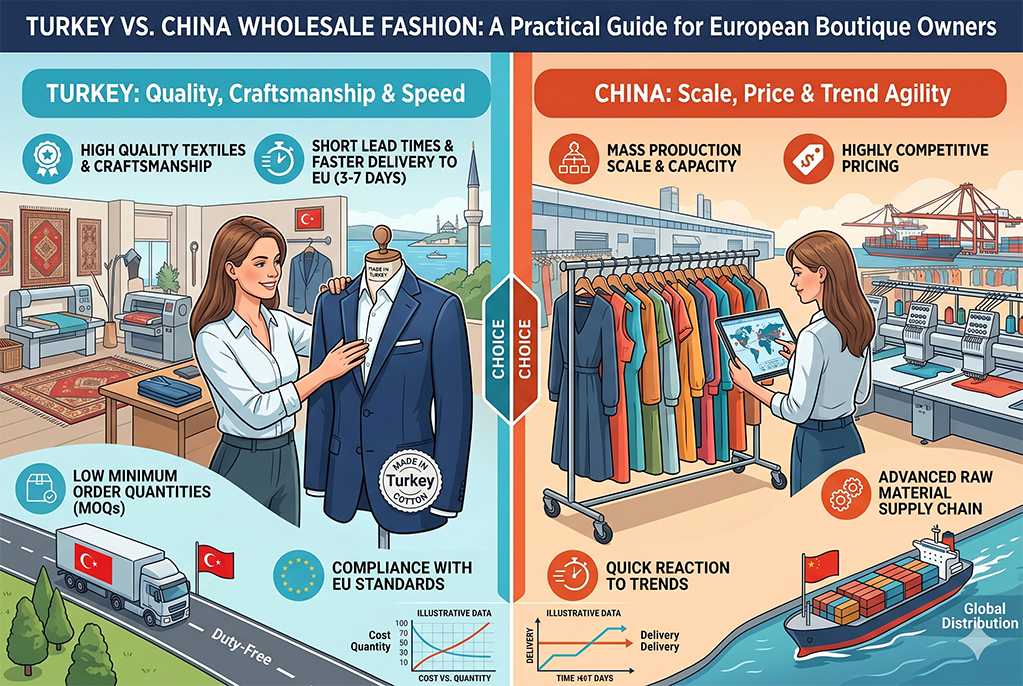
When European boutique owners start looking for wholesale fashion suppliers, two countries come up most often: Turkey and China. Both are major textile exporters. Both offer competitive pricing. But for a boutique in Spain, Portugal, France, or Germany, the right choice depends on factors that go far beyond the price tag.
This guide compares Turkey and China across the dimensions that matter most to small and medium fashion retailers in Europe — delivery time, quality, minimum orders, customs, trend alignment, and total cost of sourcing.
At a Glance: Turkey vs China for European Buyers
| Factor | Turkey | China |
|---|---|---|
| Delivery to EU | 6–9 business days | 3–6 weeks |
| Customs treatment | A.tr preferential tariff (EU customs union) | Full import duties apply |
| Quality level | High — European-grade fabrics and finishing | Variable — depends heavily on factory |
| Minimum order quantities | Low to medium — small runs available | Often high, especially for manufacturing |
| Trend alignment | Aligned with EU/Mediterranean fashion cycles | Typically 1–2 seasons behind EU trends |
| Private label small runs | Yes — boutique quantities available | Usually requires larger minimums |
| Language and communication | English and EU languages widely available | Variable — often requires intermediary |
| Returns and disputes | Easier to manage with EU-Turkey proximity | Difficult due to distance and time zones |
| Price per unit | Competitive — higher than China but lower than EU | Lowest per unit at scale |
Delivery Time: The Most Important Factor for Boutiques
For a boutique owner, inventory timing is everything. A collection that arrives two months late is a collection you cannot sell at full price.
From Turkey: Zigzax ships from Istanbul every Thursday and Friday. Orders arrive in Spain in 6 business days, Portugal in 7, and most other EU countries within 6–9 business days. This means you can respond to a trend or restock a selling item within the same week.
From China: Standard shipping from China to Europe takes 3–6 weeks by sea freight. Air freight from China is faster — typically 7–14 days — but the cost difference makes it impractical for most wholesale orders. The result is that most boutiques ordering from China need to plan 6–10 weeks in advance.
Verdict: For boutiques that need to respond quickly to market demand, Turkey has a decisive advantage. The delivery difference alone — 6 days vs 3–6 weeks — changes how you manage inventory, cash flow, and seasonal risk.
Customs and Taxes: Where Turkey Has a Structural Advantage
This is the factor most buyers underestimate when they first compare Turkey and China.
Turkey and the EU have a customs union for industrial goods, including textiles and clothing. This means Turkish-manufactured clothing can enter any EU country under preferential tariff conditions using an A.tr movement certificate. In practice, this means:
- No import duties on Turkish-manufactured clothing entering the EU
- No surprise charges at the border
- Faster customs clearance
Chinese goods entering the EU are subject to full import duties. Depending on the product category, EU import tariffs on clothing from China typically range from 10% to 12%. On top of this, VAT applies upon import. For a €10,000 wholesale order from China, you may be paying €1,000–€1,500 in import duties before the goods even reach your warehouse.
When comparing prices between Turkish and Chinese suppliers, always add the import duty cost to the Chinese price. The gap narrows significantly.
Zigzax handles all A.tr documentation for every shipment. All EU duties and taxes are included in our pricing. There are no hidden fees.
Verdict: Turkey’s customs union status with the EU gives it a structural pricing advantage over China that is not reflected in the per-unit cost alone.
Quality and Fabric Standards
Turkish textile manufacturing has a long history of supplying European fashion brands. Major EU retailers including Zara and H&M source from Turkish factories. The country’s textile industry operates to OEKO-TEX and GOTS standards for many product lines.
Turkish garments are generally produced with European-grade fabrics, finishing, and sizing. The physical proximity to European markets means Turkish manufacturers are familiar with EU consumer expectations — fit, fabric weight, washing performance, labelling requirements.
Chinese garments vary enormously in quality. At the premium end, Chinese factories produce excellent garments for global luxury brands. At the low end, quality control issues — inconsistent sizing, poor finishing, misrepresented fabrics — are common. Without visiting the factory or working with a trusted sourcing agent, the quality risk is higher.
For a boutique owner who cannot inspect every shipment, this matters. Zigzax verifies fabric, colour, and model for every order before shipment, and sends photos for client approval. If the product does not match what was requested, it does not ship.
Verdict: For boutiques selling to EU consumers with EU quality expectations, Turkish garments generally require less quality management than equivalent-priced Chinese goods.
Minimum Order Quantities
Turkey: Turkish manufacturers, especially in Istanbul’s Merter, Güngören, Zeytinburnu, and Laleli districts, work with lower minimum order quantities than most Chinese factories. Small boutiques can order mixed styles in small quantities. Zigzax consolidates orders from multiple suppliers into one shipment — so you are not locked into a large single-supplier order.
China: Chinese factories, particularly for manufacturing and private label, typically require higher minimum orders. For standard wholesale of finished goods, minimums vary, but for private label production, many Chinese factories require 500–1,000 pieces per style minimum. This is impractical for most independent boutiques.
Verdict: For boutiques that need variety and flexibility — multiple styles in small quantities — Turkey is more practical.
Trend Alignment with EU Markets
Fashion is regional. What sells in Istanbul’s boutiques in March is what sells in Barcelona and Milan in April. Turkey’s fashion industry operates on the same seasonal cycle as Europe.
Chinese wholesale fashion typically follows global trend reports with a 1–2 season lag. This is not a criticism — it reflects the production scale and lead times inherent in mass manufacturing. But for a boutique owner who needs to be current, the gap is real.
Verdict: For trend-sensitive boutiques targeting EU consumers, Turkish fashion is more aligned with current EU market demand.
When Does China Make More Sense?
This guide is not arguing that China is the wrong choice for every buyer. There are scenarios where sourcing from China makes sense:
- Very high volume orders where the per-unit cost advantage at scale outweighs the logistics and duty costs
- Basic, non-trend-dependent items such as plain t-shirts, basics, and accessories where trend timing is irrelevant
- Specific product categories where China has manufacturing specialisation that Turkey does not match (electronics accessories, certain home goods)
- Buyers outside the EU where Turkey’s customs union advantage does not apply
For most European boutique owners sourcing fashion — particularly clothing, dresses, sets, and accessories — Turkey offers a better combination of delivery speed, quality, customs treatment, and minimum order flexibility.
Total Cost of Sourcing: An Honest Comparison
When boutique owners compare Turkey and China, they often compare only the per-unit product price. This misses several cost components:
| Cost component | Turkey (via Zigzax) | China (standard) |
|---|---|---|
| Per-unit product cost | Medium | Lower |
| Import duties to EU | Included (A.tr, zero duty) | 10–12% of product value |
| Shipping cost | €165/package (30 kg, 6–9 days) | Variable — sea: low but slow; air: expensive |
| Inventory holding cost | Low — fast replenishment (6–9 days) | High — 6–10 week lead time requires larger stock |
| Quality control risk | Low — photo approval before shipment | Higher — harder to verify remotely |
| Trend risk | Low — same-season EU alignment | Higher — 1–2 season lag |
| Total effective cost | Competitive when all factors included | Often higher than per-unit price suggests |
Verdict: When you account for import duties, shipping time, inventory carrying costs, and quality risk, Turkey is more cost-effective for EU boutiques than the per-unit product price comparison suggests.
Practical Recommendation
If you are a boutique owner in Spain, Portugal, France, Germany, or anywhere in the EU, and you are choosing between Turkey and China for wholesale fashion sourcing, our recommendation is:
Start with Turkey for fashion clothing, sets, dresses, and accessories. The delivery speed, customs treatment, quality consistency, and low minimum orders make it the most practical option for the majority of EU boutique operators.
Consider China only for very specific, high-volume, non-trend-dependent categories where the scale advantage justifies the lead time and duty costs.
Zigzax Fashion Agency has been sourcing wholesale fashion from Istanbul’s manufacturer districts since 2017. We ship to all EU countries with all customs and taxes included, in 6–9 business days.
If you want to compare specific products, pricing, or availability, contact us directly.
Get in Touch
- WhatsApp AI: +90 507 844 40 10
- Istanbul office: +90 546 420 88 68
- Barcelona office: +34 683 266 291
- Email: info@zigzax.agency
- Telegram: t.me/zigzaxagency
- Product catalogue: zigzax.agency/shop
Zigzax Fashion Agency — Istanbul & Barcelona
Wholesale fashion sourcing and logistics from Turkey to Europe since 2017